

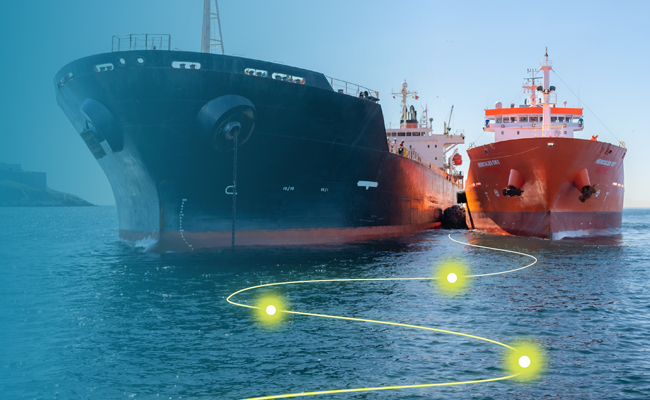
Biofuels are increasingly positioned as an immediate pathway to reduce emissions in shipping. As drop-in fuels, they can be used within existing vessel operations, without the need for retrofits. Peninsula supports customers in applying these solutions in real operating conditions, helping translate market potential into practical outcomes.
Market signals support this shift. The marine biofuels sector is projected to grow from USD 8.15 billion in 2026 to USD 16.5 billion by 2036, alongside rising adoption in key bunkering hubs.
In Singapore, bio-bunker sales reached 1.36 million metric tonnes in 2025, increasing by 54.4% year-on-year. At the same time, the Port of Rotterdam has seen bio-LNG volumes increase more than sixfold.
However, translating these trends into day-to-day fuel decisions is less straightforward. This is particularly evident in environments where pricing, availability and logistics must be assessed simultaneously.
Commercial reality goes beyond pricing
In recent months, market conditions have shifted in ways that improve the relative competitiveness of biofuels.
In the ARA region, B100 premiums over marine gasoil narrowed significantly amid shifting energy market dynamics. While B100 currently trades at a modest premium to conventional marine fuels, the differential remains substantially below historical levels, supporting the commercial case for adoption.
Under these conditions, the economic case is clear.
But bunker decisions are not made in isolation. They sit within commercial frameworks where cost, risk and responsibility are often split across different stakeholders.
Fuel selection is influenced as much by contractual arrangements as by market pricing, and decision-making is typically distributed across owners, charterers, operators and technical managers, each with different priorities and exposures.
In many cases:
- Charterparty agreements limit flexibility around fuel choice
- Compliance benefits are not realised by the party paying for the fuel
- Risk sits with those least able to influence the decision
This creates a disconnect between theoretical value and actual uptake. Even when biofuels make commercial sense at a system level, they may not align with the incentives of individual stakeholders.
Recent developments are beginning to address these constraints. Initiatives such as the BIMCO Biofuel Clause for Time Charter Parties 2026 provide a framework for owners and charterers to agree the use of biofuels within predefined parameters, helping to improve flexibility around fuel selection and reducing some of the contractual barriers that have historically limited uptake.
Technical capability within operational limits
From a technical perspective, biofuels are already viable within existing operations. However, their use is defined by practical parameters:
- Engine manufacturer certifications and blend limits
- Warranty and insurance considerations
- Availability of compliant fuels at the required time and location
As a result, usage tends to focus on blends, commonly in the B20 to B30 range, reflecting both supply conditions and operational requirements.
This means implementation is often voyage-specific, rather than applied consistently across a fleet.
Regulation, incentives and real-world application
Regulatory frameworks are a key factor shaping biofuel adoption. FuelEU Maritime introduces progressive reductions in greenhouse gas intensity, starting at 2% in 2025 and increasing over time. At the same time, emissions costs under the EU ETS create a direct financial incentive to reduce carbon exposure.
However, these drivers are not uniform. Compliance depends on where vessels operate, meaning demand is often route-driven rather than a fleet-wide strategy.
Additional considerations, such as over-compliance risk, credit timing and allocation, further influence how operators approach fuel decisions.
Across the market, the fundamentals are increasingly aligned:
- Stronger regulatory drivers
- Improving pricing dynamics
- Growing supply infrastructure
Yet the critical question is not whether biofuels are viable. It is how consistently they can be applied within real operating conditions, where commercial agreements, technical limits and voyage planning intersect.
In Peninsula’s experience, this is where the gap remains most visible, between what is commercially viable in theory and what can be implemented in practice across real supply conditions. Demand is increasing, particularly in key hubs such as ARA, but utilisation does not yet reflect the full extent of the underlying opportunity.
Turning complexity into practical application
As the industry moves forward, the focus is shifting towards execution. This requires a practical understanding of how commercial, technical and regulatory factors interact in real operating conditions.
This includes understanding:
- How fuel decisions are influenced by charterparty terms
- Where technical limits apply in real operations
- How compliance exposure translates into cost
- What conditions enable reliable supply
These factors determine whether biofuels are adopted not just in principle, but in practice.
From market signals to operational delivery
Biofuels are already part of the marine energy landscape. Their role will continue to grow as regulation tightens and fuel flexibility becomes more important.
What matters is how they are applied in real-world conditions, where commercial, technical and operational considerations must be aligned at the point of supply.
Sustainable Biofuels with Peninsula
Peninsula delivers biofuels in practice, aligning sourcing, blending and delivery to support customers in managing commercial requirements, operational constraints and evolving regulatory frameworks.
Marine Biofuels:
Available today
Our biofuel guide showcases how we can support your decarbonisation strategy
